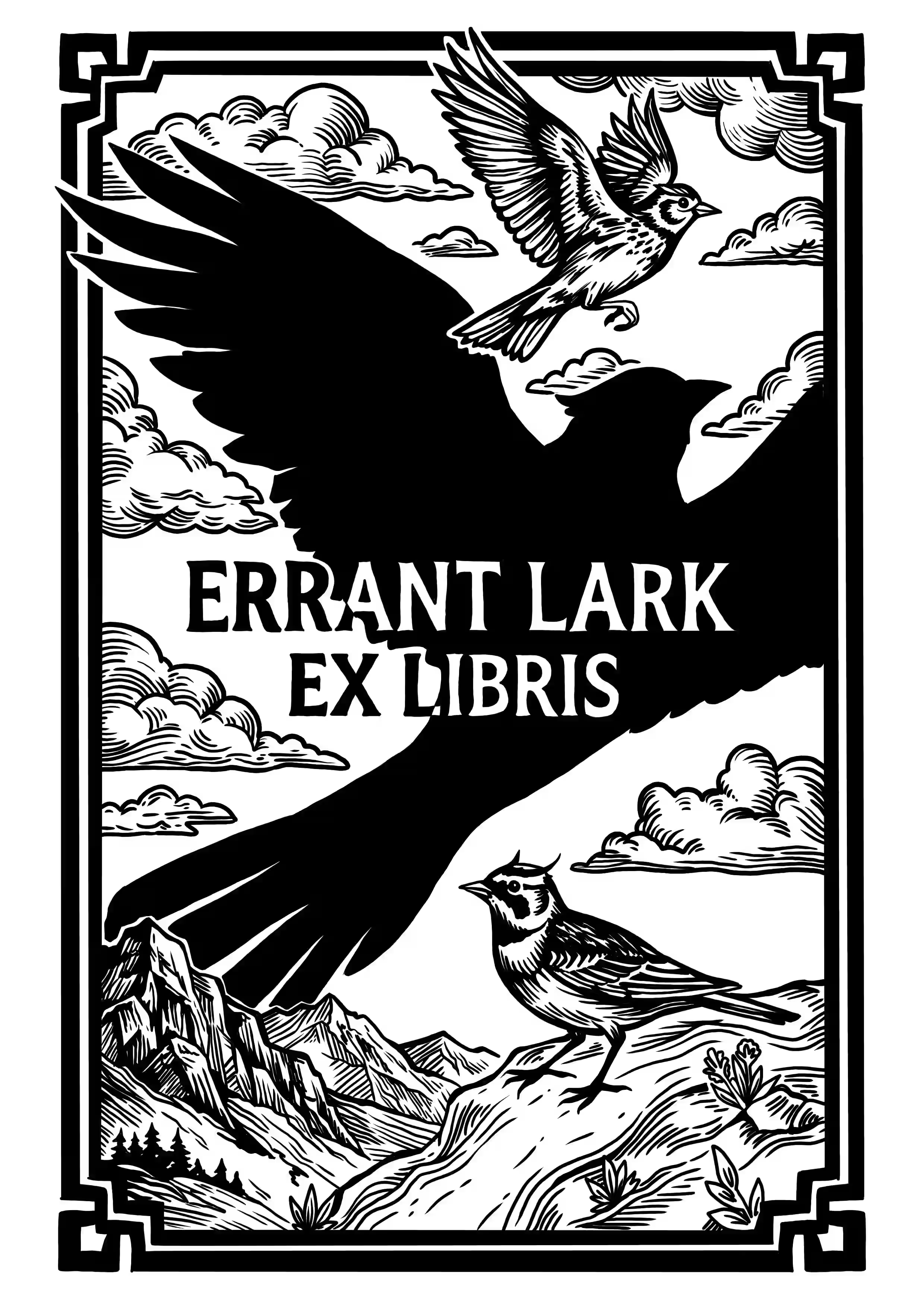
Ex Libris Generator vs Custom Design: DIY, Templates & AI Compared

I wanted to know whether you can make a genuinely good Ex Libris yourself.
So I tried the options people actually use.
Free templates. Online bookplate makers. Ex Libris generators. Canva. AI image tools. Rubber stamps. Even carving a stamp by hand.
Some worked surprisingly well.
Others looked good for about five seconds.
And eventually I realized there are really two different questions hiding behind "Can I make my own Ex Libris?"
Can you make a bookplate that marks your books as yours?
Absolutely.
Can you make one that feels like it was created specifically for you and your library?
That's a much harder problem.
Quick Answer: Is an Ex Libris Generator Worth It?
If you just need a simple bookplate, an Ex Libris template or online bookplate maker can be perfectly useful. They're inexpensive, fast, and easy to customize.
If you want an original design built around your personality, interests, symbols, and the books you collect, a generator or template has obvious limits. It can rearrange existing elements, but it can't really interpret why those elements matter to you.
That's where custom Ex Libris illustration starts to make sense.
Cost Comparison: What Each Option Actually Costs
| OPTION | COST | UNIQUENESS | QUALITY | TIMELINE |
|---|---|---|---|---|
| Free templates | $0 | Low | Basic | Instant |
| Online bookplate maker | $5-$15 | Low | Medium | Minutes |
| AI-generated | $0-$20 | Medium | Inconsistent | Minutes |
| DIY stamp carving | $10-$30 | High | Variable | Hours to days |
| Custom illustration | $100 | Total | Highest | 5-10 days |
The price isn't really the most important difference.
The bigger difference is what you're actually buying.
A template gives you a ready-made design.
A custom illustration gives you a design that starts with you.
Why I Tried Making My Own Ex Libris
The idea makes sense.
Why pay for a custom illustration when you can find an Ex Libris template, put your name on it, and print it yourself?
Especially when there are free tools everywhere.
I wanted to see how far DIY could actually go.
Could I create something that looked good?
Could I make something personal?
Could an Ex Libris generator or AI tool produce something I'd genuinely want to put inside my books?
So I tried them instead of guessing.
The biggest thing I learned was that most DIY tools are very good at solving the ownership problem.
They're much less good at solving the design problem.
Free Ex Libris Templates and Printable Downloads
This is the easiest place to start.
Search for a free Ex Libris template or printable bookplate and you'll find plenty of options.
What's Available
Most templates come from:
- Printable resource websites
- Design platforms such as Canva
- Label companies
- Old clip art collections
- Bookplate and stationery websites
The designs tend to follow familiar formulas.
Decorative border. Fancy typography. "This Book Belongs To." Maybe an owl, a stack of books, a feather, or a botanical frame.
There is nothing wrong with that if that's what you want.
What You Get
I tried several templates. The good part is obvious.
You add your name, print the design, and you're done.
The limitations are just as obvious.
Everyone has access to the same artwork. The imagery usually isn't connected to you personally. And some templates are really labels with decorative elements rather than carefully designed Ex Libris artwork.
That distinction matters if the bookplate itself is supposed to feel special.
Who Ex Libris Templates Work Well For
Templates make sense if:
- You need something quickly
- You're labeling children's books
- You lend books regularly
- You want a temporary solution
- You simply don't care much about personalization
If you just want to mark a book as yours, a template can do that job perfectly well.
But if you've spent years building a personal library, you may want something that feels more like part of the collection.
Is There Really an Ex Libris Generator?
This was one of the things I was most curious about.
People search for:
- Ex Libris generator
- Ex Libris maker
- Ex Libris template
- Design your own bookplate
- Make your own bookplates
So I expected to find dedicated software that could create a genuinely original Ex Libris from a few choices.
What I mostly found were customizers. And there is an important difference.
A generator creates something new. A customizer lets you rearrange existing pieces.
Most online bookplate makers let you:
- Change your name
- Pick a font
- Choose a border
- Add an icon
- Adjust a layout
- Change a few colors
That's useful.
But you're still working inside someone else's design system.
I Tried Several Online Bookplate Makers
I tested multiple tools.
The good:
They're quick. They're beginner friendly.
You don't need design experience.
Within a few minutes, you can have something printable.
The problem appeared after trying several different websites.
The designs started blending together.
Different fonts. Different borders. Different icons.
But the same basic idea.
You're selecting from a menu rather than actually designing something from scratch.
Where Online Ex Libris Makers Start Falling Apart
Imagine two readers.
One collects Victorian literature and loves old architecture.
The other loves astronomy, forests, and mythology.
Both might choose a raven, a moon, or a botanical border from an online maker.
The final designs can still look surprisingly similar because both people are choosing from the same limited library of elements.
That's the limitation of an Ex Libris maker.
It can personalize a design.
It can't really interpret a person.
Personalized Bookplates vs Generic Templates
This is where the comparison becomes less about features and more about intent.
Why do you want an Ex Libris?
If the answer is:
"I don't want people taking my books."
Then almost any template will do.
If the answer is:
"These books are part of my life."
Then you're solving a different problem.
A personalized Ex Libris can include things like:
- Favorite authors
- Mythology
- Architecture
- Wildlife
- Astronomy
- Family history
- Dark Academia influences
- Botanical elements
- Meaningful objects
- Hobbies outside reading
The point isn't to put every interest into one illustration.
It's to create something that still feels like you years from now.
A generic template labels ownership.
A personalized bookplate can express identity.
Can AI Design Your Ex Libris?
This was the option I expected to perform best.
If AI can generate elaborate illustrations, surely it can create an Ex Libris.
I tested prompts such as:
- vintage Ex Libris
- gothic bookplate
- botanical library stamp
- owl Ex Libris
- personalized bookplate illustration
Some results looked genuinely beautiful.
But looking good on screen and working as an actual bookplate are two different things.
The Biggest Problem: Typography
Names and text were the first major problem.
Letters were misspelled.
Words became distorted.
Latin phrases turned into strange characters.
Even when the illustration looked excellent, the part that actually identified the owner could be unusable.
For an Ex Libris, that's a serious limitation.
AI Doesn't Understand How Bookplates Are Used
A bookplate has to work at a small size.
Fine details disappear.
Thin lines become muddy.
Typography becomes harder to read.
An AI image can look incredible at a large resolution and fall apart when reduced to a three-inch bookplate.
That doesn't make AI bad.
It just means generating an image and designing a functional bookplate aren't the same task.
Every Revision Starts Again
This was another problem.
Imagine you like the raven and the border, but want the moon moved slightly higher.
With an illustrator, that's a revision.
With an image generator, you often generate another image and hope it keeps everything you liked.
Sometimes it does.
Often it doesn't.
You end up choosing between versions instead of refining one design.
Where AI Actually Helps
I wouldn't dismiss AI completely.
It's excellent for brainstorming.
It can help you discover visual directions, combinations of symbols, moods, and styles you might not have considered.
For inspiration, it's useful.
For a finished Ex Libris that needs accurate typography, controlled composition, and reliable print production, I wouldn't rely on it alone.
Ex Libris Stamp vs Printed Bookplates
Another thing I learned while testing DIY options is that the way a bookplate will be used should influence the design from the beginning.
Printed Bookplates
Printed bookplates are usually placed inside the book cover and can support:
- Detailed illustration
- Vintage engraving styles
- Decorative typography
- Ornate borders
- Shading
- Complex compositions
Print gives you much more freedom with detail.
Ex Libris Stamps
A stamp works differently.
Ink doesn't forgive tiny details.
You need stronger contrast, cleaner lines, and enough open space for the design to remain readable.
A design that looks beautiful on a screen can become a dark, muddy shape after being turned into a stamp.
That's why production needs to be considered during the design process, not afterwards.
What Size Should a Bookplate Be?
There isn't one universal bookplate size.
Many printed bookplates fall around:
- 2 × 3 inches
- 3 × 4 inches
Smaller bookplates can work beautifully in compact books.
Larger designs give detailed illustrations more room to breathe.
The important thing is to choose the size based on the book, the design, and how you plan to use it.
If you're considering a stamp or embosser later, think about that before finalizing the artwork. Some illustrations scale beautifully. Others lose important details when reduced.
DIY Stamp Carving: The Hands-On Approach
This was probably the most enjoyable option.
Instead of designing digitally, you carve the design into rubber or linoleum and print every book yourself.
There's something satisfying about that.
Every impression is slightly different.
Every book carries a little bit of the process.
The Good
- Inexpensive materials
- Rewarding hobby
- Handmade character
- Complete creative control
The Difficult Part
It's much harder than it looks.
Especially when you're trying to carve:
- Lettering
- Fine borders
- Botanical illustrations
- Detailed animals
Unless you've already worked with printmaking, there is a learning curve.
My respect for traditional printmakers definitely increased after trying it.
What DIY Gets Right
It would be unfair to pretend DIY has no advantages.
It absolutely does.
Speed
You can start today.
Some templates take less than five minutes.
Cost
Many options are free.
Even paid tools are inexpensive compared with commissioned artwork.
Low Commitment
Not sure whether you'll actually use bookplates?
DIY lets you experiment before spending more money.
It's Good Enough for Many Libraries
Not everyone needs custom illustration.
If your goal is simply marking ownership, DIY succeeds.
Mission accomplished.
There's no reason to overcomplicate it.
What DIY Still Can't Do
But there is a gap between functional and meaningful.
It Can't Understand Your Story
You can tell AI to draw a raven.
You can tell a template to use a certain border.
You can tell a generator to add your initials.
But none of those systems know why you chose those things.
Maybe the raven reminds you of your grandfather.
Maybe it comes from your favorite poem.
Maybe it's simply the bird you notice every morning.
Those details matter because you understand them.
That's what makes a personalized Ex Libris feel different every time you open a book.
Understanding what symbols mean is only the beginning. Translating those symbols into one coherent design is the difficult part.
Everything Starts Looking Familiar
After testing templates and online tools, I noticed something strange.
Even when the artwork changed, everything still felt similar.
The same Victorian borders.
The same owls.
The same flourishes.
The same fonts.
Eventually you stop seeing the individual designs and start recognizing the template they came from.
Nobody Challenges Your Ideas
This was something I didn't expect to miss.
A conversation.
When you're designing alone, every decision comes from you.
When you work with an illustrator, they can ask why a particular symbol matters.
Maybe you say, "I want an owl."
The useful question might be:
"Why an owl?"
Sometimes that question changes the entire direction of the design.
Not because your original idea was wrong.
Because there was a better idea underneath it.
That kind of collaboration doesn't exist with a template or generator.
Production Is Easy to Ignore
A design can look fantastic on your monitor and still fail as:
- A stamp
- An embosser
- A sticker
- A printed bookplate
Line thickness, spacing, contrast, typography, and final size all matter.
They're easy to overlook when you're focused only on making something beautiful.
They're much harder to fix afterwards.
What Makes a Good Bookplate Design?
The more options I tested, the less I cared about individual illustrations.
I started paying attention to why some bookplates immediately felt right while others felt like decorative labels.
A good Ex Libris should:
- Stay readable at a small size
- Balance illustration and typography
- Avoid unnecessary detail
- Communicate a clear mood
- Work well in its intended format
- Still look good years later
That's surprisingly difficult.
Not because drawing is necessarily difficult.
Because restraint is difficult.
The best bookplates usually aren't the busiest ones.
They're the ones where every element has a reason to exist.
DIY or Custom: Which One Should You Choose?
After trying the different options, I don't think there is a universal winner.
It depends on what you actually want from your bookplate.
DIY Makes Sense If
- You need something quickly
- Your budget is very limited
- You're labeling books for children
- You're testing whether you'll actually use bookplates
- You don't mind using artwork other people can also access
In those situations, I'd honestly recommend DIY.
You'll save money and have something usable very quickly.
Custom Illustration Makes Sense If
- Your library is something you've built over many years
- You want artwork that feels genuinely personal
- You're planning to order a stamp or embosser
- You're buying it as a meaningful gift
- You enjoy collaborating with an artist
- You expect to keep using the design for decades
At that point, the price difference starts feeling surprisingly small.
A custom bookplate is something you can use hundreds of times over the years.
What Working With an Illustrator Actually Feels Like
One misconception I had before working on custom artwork was that you need to arrive with a finished concept.
You don't.
Sometimes the starting point is simply:
"I'd like something a little Gothic."
Or:
"I've always loved forests."
Or:
"I collect books about astronomy."
That's enough.
The interesting part is discovering what connects those ideas.
A first sketch can reveal possibilities neither person expected at the beginning.
That's one of the biggest differences between buying a ready-made design and creating one.
You're building it together.
Frequently Asked Questions
What does Ex Libris mean?
Ex Libris is Latin for "from the books of" and traditionally appears on a bookplate to identify its owner.
Is there a free Ex Libris generator?
Most tools advertised as free Ex Libris generators are actually templates, customizers, or basic bookplate makers. They can help you assemble a design, but they generally don't create a fully original illustrated Ex Libris around your personal story.
Can I design my own Ex Libris?
Absolutely. Templates, Canva, AI tools, online bookplate makers, and traditional stamp carving can all be used to make your own bookplate.
The real question is how much customization and originality you want.
Can AI create a good bookplate?
AI can generate beautiful bookplate-style illustrations, but it still has problems with typography, consistency, controlled revisions, and print-ready artwork.
It's excellent for brainstorming and inspiration. A finished Ex Libris often needs additional design work.
What size should a bookplate be?
Many bookplates are around 2 × 3 inches or 3 × 4 inches, although the ideal size depends on the book, the design, and whether you're making a printed bookplate, stamp, or embosser.
What's the difference between a template and a custom bookplate?
A template uses a design made to work for many people. A custom bookplate is created specifically for one person and can incorporate their interests, symbols, and preferred style.
What's the difference between a printed bookplate and an Ex Libris stamp?
A printed bookplate is usually a paper label placed inside the book. An Ex Libris stamp applies the design directly with ink.
Because stamps work differently, they usually need simpler artwork, stronger contrast, and cleaner lines.
Are personalized bookplates worth it?
If you only need to mark ownership, probably not.
If your library reflects years of interests, memories, and discoveries, a personalized bookplate can become part of the collection itself.
How much does a custom bookplate cost?
AleksandraInk custom Ex Libris designs are currently $100.
My Final Thoughts
When I started this experiment, I genuinely thought I'd end up recommending DIY.
And for many people, I still do.
Templates are fast.
Bookplate makers are simple.
AI is useful for ideas.
DIY stamp carving is genuinely fun.
All of those options have their place.
But none of them gave me the feeling I was actually looking for.
The moment I imagined opening the same book twenty years from now, I realized I didn't just want something with my name inside it.
I wanted something that felt like it belonged there.
That's the difference.
Templates help you label a book.
A personalized Ex Libris can become part of your library's story.
If you'd rather have something designed specifically around your own library, you can learn more about my custom Ex Libris process.
