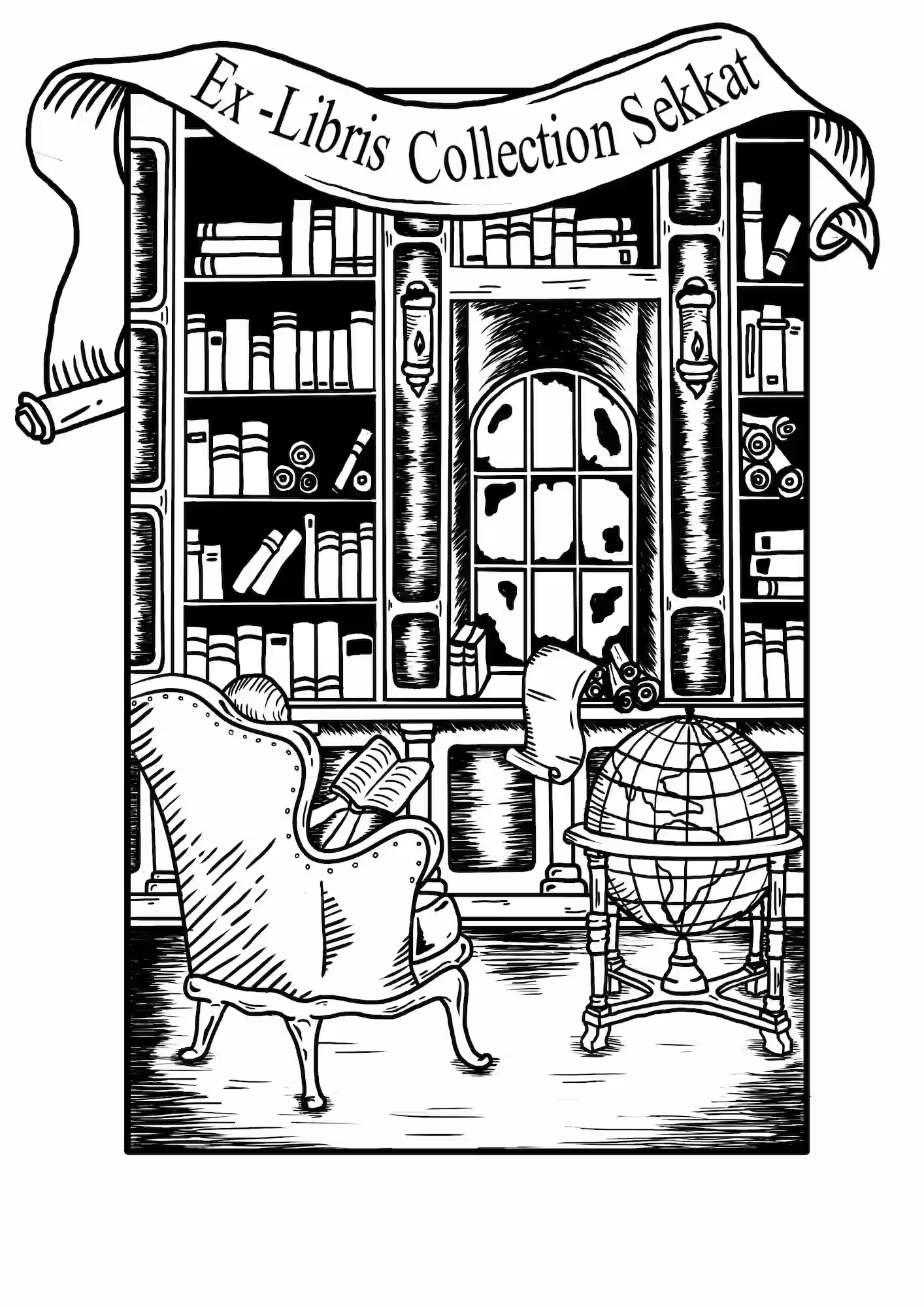
The History of Bookplates - From Medieval Libraries to Modern Bookshelves

The first time I held an old book with a handmade bookplate inside, I spent more time looking at that tiny piece of paper than reading the first chapter.
It wasn't just beautiful.
It made me wonder who had opened that same book a hundred years earlier.
Who chose that illustration?
Who placed it there so carefully?
Did they imagine someone else would still be looking at it generations later?
That's one of my favorite things about bookplates.
They don't just tell you who owns a book.
Sometimes they quietly tell you who used to own it.
Before There Were Bookplates
Books weren't always something people collected.
For centuries, they were incredibly expensive.
Long before printing presses made books widely available, every manuscript had to be copied by hand. Owning even a small collection was something only monasteries, universities, wealthy families, and a handful of scholars could afford.
When a single book could take months to produce, losing one wasn't a small inconvenience.
It was a serious loss.
Owners needed a way to identify their books, but the familiar printed bookplate didn't exist yet.
Instead, they often wrote their names directly inside the manuscript or added handwritten ownership notes.
Those simple inscriptions were the earliest ancestors of the bookplate.
The Printing Press Changed Everything
Everything began to change in the fifteenth century.
As printed books became more common, private libraries slowly started growing.
More books meant one new problem.
How do you remember which books belong to you?
Instead of writing a name by hand inside every volume, people began attaching decorative printed labels to the inside cover.
For the first time, ownership and art came together in one small design.
That idea would remain remarkably unchanged for hundreds of years.
The Earliest Bookplates
Many of the earliest surviving bookplates were created in Germany during the late fifteenth century.
They looked very different from many modern designs.
Family coats of arms were common.
Religious imagery appeared frequently.
Decorative borders filled the remaining space.
These weren't simply practical labels.
They reflected status, education, family history, and personal identity.
In many ways, they were tiny works of art hidden inside a book.
Looking through collections today, it's fascinating to see how much personality could fit into such a small space.
Bookplates Became Personal
As books became more affordable, bookplates slowly changed too.
They were no longer reserved for nobility or large institutions.
Writers, scientists, teachers, collectors, and passionate readers all began creating their own.
That's when you start seeing more individuality.
Instead of formal heraldry, bookplates began featuring landscapes, animals, libraries, symbols, and scenes connected to the owner's interests.
Looking through historical collections, that's the point where I stop seeing ownership labels and start seeing personalities.
They stopped being symbols of status.
They started becoming portraits without faces.
You could learn something about the owner before reading a single page.
Different Countries, Different Styles
One of the things I enjoy most while researching historical bookplates is seeing how differently each country interpreted the same idea.
German examples often leaned toward detailed heraldic designs.
British bookplates became known for elegant engraving and typography.
French artists introduced more decorative flourishes.
As illustration styles evolved, so did bookplates.
Art Nouveau, Arts and Crafts, Art Deco, and countless other movements all left their mark.
Even without reading the name, you can often guess roughly when a bookplate was created simply by looking at the artwork.
That's part of what makes old collections so enjoyable to explore.
The Golden Age of Bookplates
By the eighteenth and nineteenth centuries, bookplates had become far more than simple ownership labels.
Private libraries were growing.
Printing techniques had improved.
Artists had more freedom than ever before.
Instead of repeating the same heraldic designs, they began experimenting with detailed engraving, elaborate borders, landscapes, architecture, animals, and scenes inspired by literature.
Looking through collections from this period is one of my favorite ways to see how illustration styles changed over time.
Some bookplates are incredibly detailed, packed with tiny decorative elements that reward a closer look.
Others are surprisingly restrained, using only elegant typography and a small symbolic illustration.
Neither approach feels outdated.
They simply reflect different personalities.
That's something I find fascinating.
Even after hundreds of years, many historical bookplates still feel remarkably personal.
You aren't just looking at an old print.
You're catching a small glimpse of the person who once treasured the books it lived inside.
More Than Ownership
If bookplates only existed to prevent books from getting lost, they probably wouldn't have survived for so long.
People kept using them because they offered something beyond practicality.
They gave a personal library its own identity.
Some celebrated a profession.
Others reflected hobbies, favorite animals, family traditions, or a lifelong love of literature.
Every illustration hinted at the person behind the books.
That's still true today.
When I work on a custom bookplate, I'm rarely thinking about labels.
I'm thinking about stories.
The illustration should feel like it already belongs on that person's bookshelf.
Why Bookplates Never Really Disappeared
Digital reading changed many things.
But it didn't replace the feeling of opening a physical book.
In fact, I sometimes think beautifully made books have become even more meaningful because we own fewer of them.
Instead of collecting hundreds of random paperbacks, many readers build shelves filled with books they'll return to again and again.
Bookplates fit naturally into that idea.
They transform a book from something you bought into something that feels like it truly belongs in your library.
And that's probably why they're still here after hundreds of years.
They continue to do exactly what they've always done.
Only the artistic styles keep changing.
From Ownership Mark to Tiny Work of Art
Somewhere along the way, bookplates quietly stopped being just practical labels.
They became something people looked forward to designing.
A glance through historical collections shows just how personal they became.
You'll find owls perched on stacks of books, sailing ships, mountain landscapes, musical instruments, mythical creatures, gardens, observatories, printing presses, and libraries imagined in incredible detail.
No two readers built the same collection.
So why should their bookplates look the same?
That's one of the reasons I love illustrating them today.
They're small enough to fit inside a book, but they can still tell a story about the person who owns it.
The Revival of Bookplates
For a while, it seemed as though bookplates might slowly disappear.
Paperbacks became cheaper.
People borrowed more books from libraries.
Digital reading became increasingly popular.
Yet bookplates never vanished.
If anything, they've found a new audience.
Today you'll see them used by:
- passionate home librarians
- collectors of first editions
- teachers
- writers
- parents building children's libraries
- people looking for thoughtful gifts
- anyone who enjoys surrounding themselves with books
Interestingly, the motivation has changed.
Centuries ago, a bookplate often protected a valuable possession.
Today, it's more likely to celebrate one.
Looking Through History One Bookplate at a Time
One thing I've noticed while exploring historical bookplates is that they rarely feel anonymous.
Even when you know nothing about the owner, the artwork quietly leaves clues behind.
A telescope might suggest an astronomer.
A violin could belong to a musician.
An oak tree may hint at a family estate, while a stack of travel journals might reveal a lifelong love of adventure.
Of course, we can't know whether those assumptions are always true.
That's part of the charm.
Every old bookplate asks the same silent question:
"Who was this person?"
I think that's one of the reasons these little illustrations continue to fascinate collectors today.
Long after the books have changed hands, the artwork still preserves a small piece of someone's identity.
Very few objects survive in such a quiet and personal way.
Looking Back Through Someone Else's Library
One of my favorite things about antique bookplates is imagining the person behind them.
A tiny telescope might belong to an astronomer.
A greyhound could hint at a lifelong companion.
An open sea might remind someone of home.
Of course, we can't know for certain.
But that's part of the charm.
Each illustration leaves behind a small clue about a person we'll probably never meet.
Long after their books changed hands, that little piece of paper continues telling part of their story.
Very few objects do that so quietly.
Bookplates Today
Modern bookplates have far more artistic freedom than ever before.
Traditional engraving still has its place.
So do minimalist designs.
But today it's just as common to see watercolor illustrations, whimsical animals, fantasy worlds, botanical artwork, cozy reading corners, or completely original scenes created for a single person.
The tradition hasn't changed.
Only the way we express it has.
That's what makes illustrating bookplates so enjoyable.
Every project begins with the same question.
Not "What should it look like?"
But:
"What kind of library does this belong to?"
The answer is always different.
And that's exactly how it should be.
Frequently Asked Questions
How old are bookplates?
The earliest printed bookplates appeared in Europe during the late fifteenth century, shortly after the invention of the printing press. Their history spans more than five hundred years.
Who originally used bookplates?
Early bookplates were most commonly owned by wealthy families, religious institutions, universities, and scholars who maintained valuable libraries.
Are bookplates still used today?
Yes. Readers, collectors, teachers, writers, and book lovers around the world still use bookplates to personalize their libraries and celebrate books they plan to keep for years.
Why were early bookplates so decorative?
Many early owners wanted their bookplates to reflect their identity, education, family history, or profession. Over time, they became small works of art as much as ownership labels.
Related Articles
- What Is Ex Libris? Discover the meaning of the famous Latin phrase and how it became part of bookplate history.
- What Is a Bookplate? Learn what bookplates are, where they're placed, and why readers still use them.
- Ex Libris vs. Bookplate Understand the difference between these closely related terms.
If you'd like to continue this centuries-old tradition with artwork created just for your library, explore my Custom Ex Libris Bookplate Illustration service.