Ex Libris vs. Bookplate - What's the Difference?

One of the questions I hear surprisingly often is:
"Is an Ex Libris the same thing as a bookplate?"
I completely understand why people ask.
Spend five minutes browsing Etsy, Pinterest, or Google, and you'll see both names used for what looks like the exact same thing. One shop sells custom bookplates. The next one offers personalized Ex Libris designs. Another mixes both terms on the same page.
At first glance, it feels like two names for one product.
The truth is a little more interesting.
They're closely related, but they aren't exactly the same. Once you understand the difference, the confusion disappears, and you'll never wonder about it again.
It Starts With One Simple Idea
Before we get into terminology, it helps to think about the purpose rather than the name.
Imagine opening a beloved novel and finding a beautifully illustrated label inside the front cover.
Maybe it features an owl surrounded by old books.
Maybe it's a quiet forest scene.
Maybe it's nothing more than elegant lettering and your name.
Whatever it looks like, it tells you one thing.
This book belongs to someone.
That's the idea both terms share.
They're both about giving a book an owner.
The difference isn't in the illustration.
It isn't in the paper.
It isn't even in the style.
It's in the wording.
A Bookplate Is the Bigger Category
When I talk with clients, I usually start with the word bookplate.
Why?
Because it's the easiest one to understand.
A bookplate is simply a decorative ownership label placed inside a book.
That's it.
It can be illustrated.
It can be minimal.
It can include a family crest, a cat sleeping on a stack of books, or nothing more than a beautifully printed name.
As long as it's made to identify the owner of a book, it's a bookplate.
Think of it as the umbrella term.
There are countless styles, themes, and layouts, but they're all still bookplates.
If you'd like to explore them in more detail, I've written a separate guide explaining What Is a Bookplate?.
So Where Does Ex Libris Fit In?
This is where people usually expect a complicated answer.
Fortunately, there isn't one.
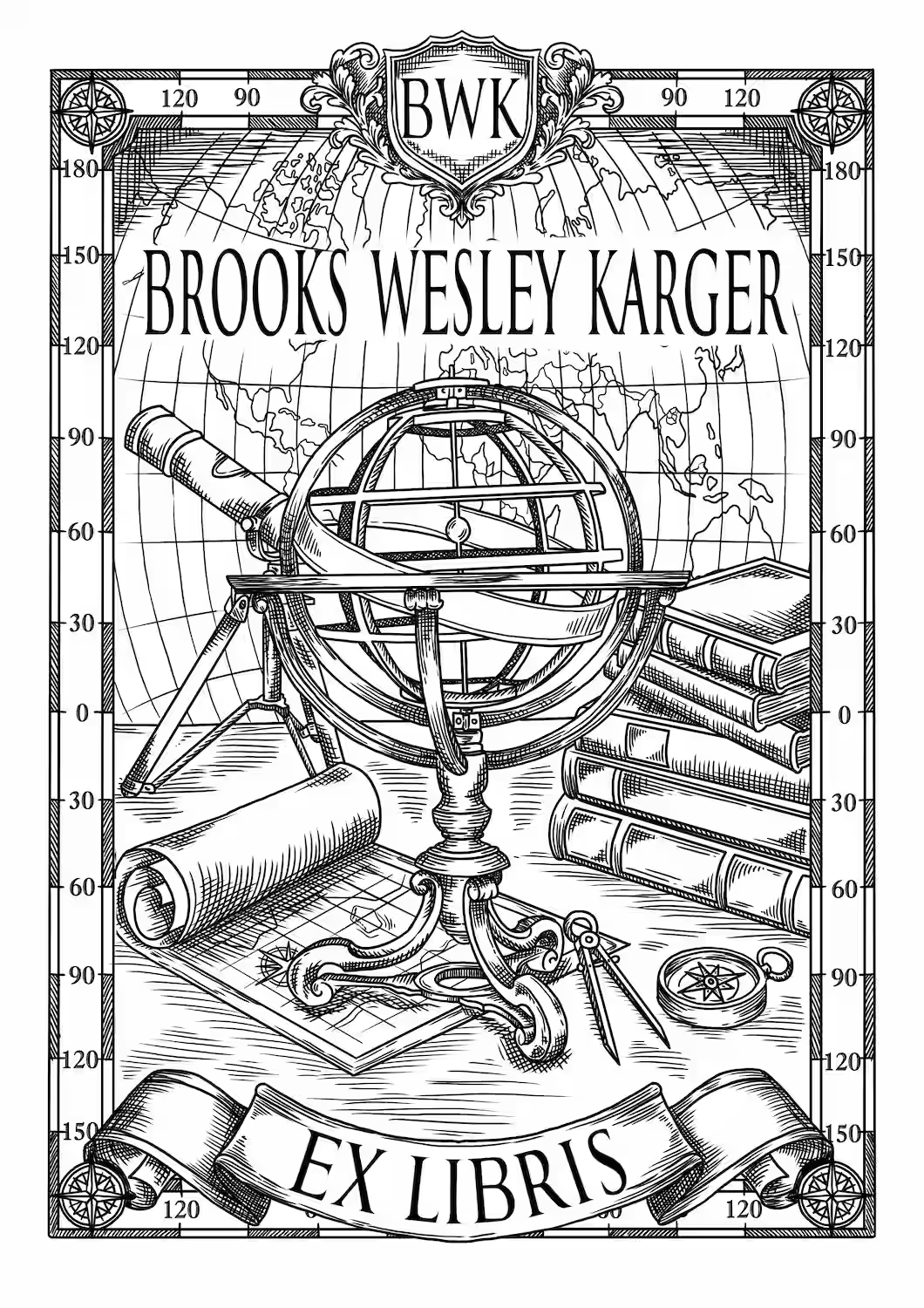
An Ex Libris is simply a bookplate that includes the Latin phrase Ex Libris.
Those two words mean "from the books of."
Traditionally, they're followed by the owner's name.
For example:
Ex Libris Amelia Carter
The artwork can be absolutely anything.
A fox reading under an oak tree.
A lighthouse overlooking the sea.
A dragon protecting a shelf of fantasy novels.
A tiny botanical illustration.
None of those subjects make a design an Ex Libris.
The Latin phrase does.
That's the only real distinction.
If you're curious about where those words came from and why people have been using them for centuries, you'll enjoy What Is Ex Libris?.
Why Almost Everyone Mixes the Two Terms
Here's something I've noticed after creating bookplates for readers.
Almost nobody asks for a "bookplate because it belongs to the broader category."
People ask for whatever term they've discovered first.
Sometimes that's bookplate.
Sometimes it's Ex Libris.
Sometimes they write and say:
"I'm not sure which one it's called, but I want one for my books."
And honestly?
That's completely normal.
The internet hasn't exactly helped.
Online shops often use both terms because people search in different ways.
Collectors sometimes prefer one.
Artists prefer another.
Even museum collections aren't perfectly consistent.
Over time, Ex Libris became almost a nickname for personalized book ownership art.
That's why the two expressions overlap so much today.
Does It Actually Matter?
Most of the time...
Not really.
If someone tells me they want an Ex Libris, I know exactly what they mean.
If they ask for a custom bookplate instead, I understand that too.
The conversation doesn't suddenly change because of the wording.
Where it does matter is when you're describing a specific design.
If the artwork actually includes the words Ex Libris, then calling it an Ex Libris is perfectly accurate.
If it doesn't, "bookplate" is usually the more precise description.
It's a small distinction, but it's a nice one to know.
Especially if you love the history behind these little pieces of paper.
The Same Artwork Can Be Both
This is probably my favorite way to explain the difference.
Imagine I finish an illustration of a raven sitting on a stack of antique books.
The artwork is complete.
Now I prepare two versions.
The first one simply says:
Eleanor Brooks
The second says:
Ex Libris Eleanor Brooks
Nothing about the illustration has changed.
Not the composition.
Not the colors.
Not the symbolism.
The only thing that's different is the wording.
One is simply a bookplate.
The other is both a bookplate and an Ex Libris.
That's why you'll often see artists offering the exact same illustration with different text options.
From an artistic perspective, they're the same piece.
From a terminology perspective, they're slightly different.
Why I Usually Ask One Question First
When someone commissions a design from me, I don't start by asking whether they want a bookplate or an Ex Libris.
I ask something much simpler.
"Do you want the words Ex Libris to appear on the finished artwork?"
Because that's usually the only decision that changes the terminology.
Everything else is about the person.
The books they love.
The stories they grew up with.
The animals, places, and little details that make the illustration feel like it belongs to them.
That's the part I find most enjoyable.
The name comes later.
Which One Should You Use?
If you're talking about the object itself, bookplate is always the safe choice.
It's the broader term, so you'll never be wrong using it.
If your design includes the words Ex Libris, then calling it an Ex Libris is equally correct.
Personally, I don't think there's much value in correcting people over it. Language changes, and these two terms have been borrowing from each other for a very long time.
What matters more is understanding why the two names exist.
Once you know that, you'll recognize both instantly, whether you're browsing an online shop, reading an auction catalogue, or opening a century-old book.
Why Online Shops Use Both Terms
If you've searched for personalized bookplates online, you've probably noticed something else.
Many shops don't choose one term.
They use both.
You'll see titles like:
- Custom Ex Libris Bookplate
- Personalized Bookplate Stamp
- Ex Libris Book Labels
- Custom Bookplate Illustration
That isn't because the sellers are confused.
They're trying to help people find what they're already searching for.
Some readers have always known the Latin phrase Ex Libris.
Others have never heard it before and simply search for "bookplate."
Using both terms makes it easier for everyone to arrive at the same destination.
It's one of those rare situations where two different search phrases often lead to exactly the same product.
What About Museums and Collectors?
This is where the terminology becomes a little more precise.
Museum collections, libraries, and collectors often pay closer attention to historical accuracy.
If an ownership label actually bears the words Ex Libris, they'll usually describe it as an Ex Libris.
If it doesn't, they'll often catalogue it simply as a bookplate.
That distinction becomes useful when documenting historical collections, comparing printing techniques, or tracing the ownership of rare books.
For most modern readers, though, it's simply an interesting detail rather than a rule that needs to be memorized.
A Good Way to Remember the Difference
Whenever someone asks me about this, I use the same comparison.
Imagine flowers.
"Flower" describes the whole category.
A rose is one particular kind of flower.
You wouldn't call every flower a rose.
The same idea works here.
A bookplate is the broad category.
An Ex Libris is one specific kind of bookplate.
Once you look at it that way, the terminology becomes surprisingly easy to remember.
Should Your Design Say Ex Libris?
This is probably the only practical decision you'll ever have to make.
Some people love the tradition.
They enjoy knowing that readers have been using those same Latin words for hundreds of years.
Others prefer something more personal.
Instead of Ex Libris, they might choose:
From the Library of Emma
Or simply:
Emma's Library
Neither option is better.
They simply create a different feeling.
One leans toward tradition.
The other feels a little more contemporary.
When I'm illustrating a custom design, I usually ask my clients which feels more like them.
That's a much more interesting conversation than debating terminology.
Frequently Asked Questions
Can a bookplate become an Ex Libris?
Yes.
If the design includes the Latin words Ex Libris, it becomes an Ex Libris. Without those words, it's simply a bookplate.
Is one term more correct than the other?
Not really.
Bookplate is the broader and technically safer term. Ex Libris is correct when the design includes the traditional Latin wording.
Why do artists use both names?
Because readers search for both.
Most artists want people to find their work, regardless of which term they already know.
Do I have to use the words Ex Libris?
Not at all.
Many modern bookplates use the owner's name, "From the Library of...", or another personal phrase instead.
Related Articles
- What Is Ex Libris? Learn where the famous Latin phrase came from and why readers still use it today.
- What Is a Bookplate? Discover what bookplates are, where they're placed, and how they became part of personal libraries.
- Bookplate Examples Explore different illustration styles and find inspiration for your own library.
If you're looking for an original illustration that's designed around your books, interests, and personality, take a look at my Custom Ex Libris Bookplate Illustration.