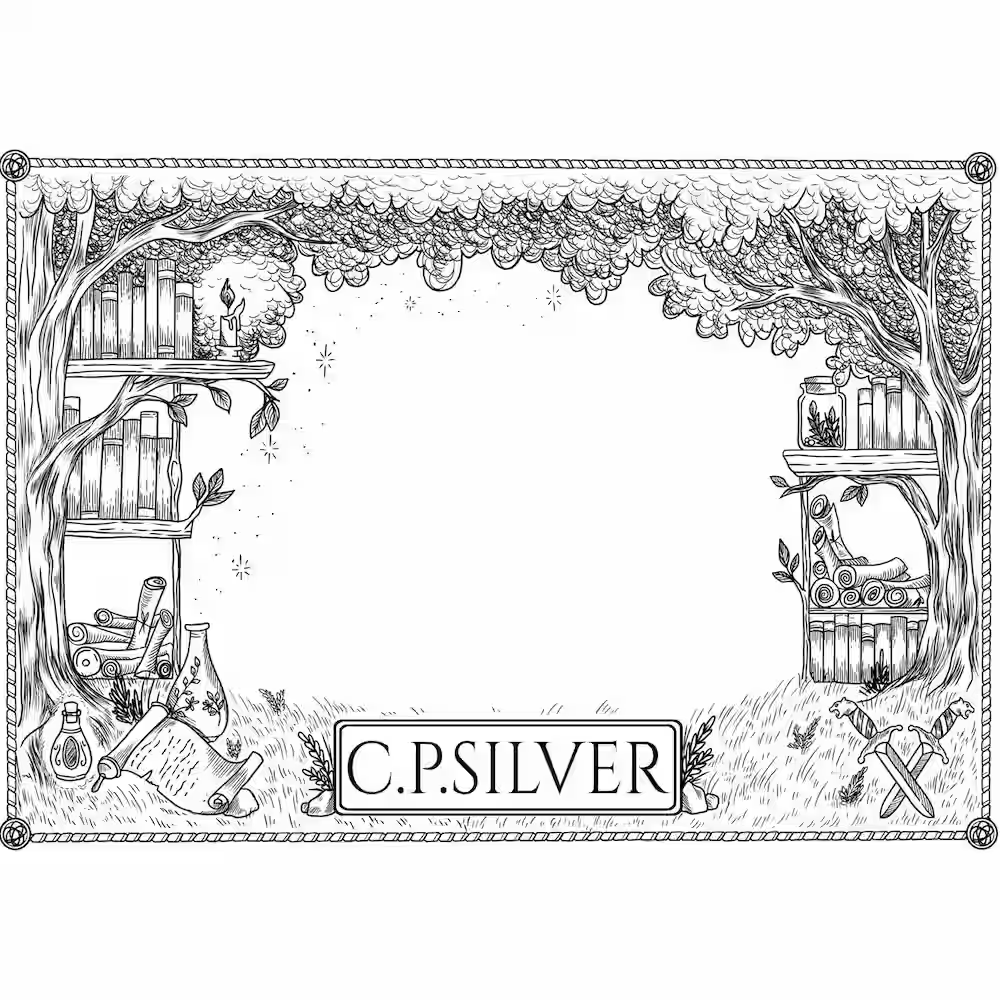
Bookplates for Authors - Personalized Ex Libris for Writers

Some writers dream about seeing their name on the cover of a book.
Others imagine the moment they sign their very first copy.
Few think about the books that quietly filled the shelves long before that happened.
Every writer has a personal library.
The novels that sparked new ideas.
The poetry collections that taught rhythm.
The history books covered in notes.
The dog-eared paperbacks that somehow survived every move.
A personalized bookplate belongs in those books just as naturally as an author's name belongs on the cover of one they've written.
Bookplates for authors are personalized Ex Libris designs created to mark a writer's personal library.
They can reflect an author's interests, recurring themes, favorite imagery, or simply the books and ideas that have shaped their work.
For many writers, it's a small tradition that connects reading, writing, and personal identity in a way very few objects can.
Every Author Has Two Stories
Readers usually know authors through the books they've published.
But every author has another story that most people never see.
It's the story told by the books they've collected.
Every shelf reveals something different.
Favorite novels.
Reference books.
Travel journals.
Collections of mythology.
Old dictionaries.
Art books with worn corners.
Those books quietly shaped the person who eventually became a writer.
A bookplate acknowledges that relationship.
Instead of simply marking ownership, it celebrates the library that helped shape every future manuscript.
Why Authors Use Bookplates
Long before publishing became what it is today, scholars, poets, historians, and writers marked their personal libraries with Ex Libris bookplates.
Sometimes they were elaborate engravings.
Sometimes they contained nothing more than a name surrounded by simple ornament.
Their purpose wasn't to impress visitors.
It was to create a sense of belonging.
Books passed between universities, private collections, friends, and colleagues.
A bookplate helped each one find its way home.
For writers, it also represented something more.
Their personal library wasn't separate from their work.
It was part of it.
That tradition still feels just as meaningful today.
A Bookplate Doesn't Need to Look Like a Writer
One assumption I hear surprisingly often is that an author's bookplate should include pens, typewriters, ink bottles, or stacks of manuscripts.
Sometimes that's exactly the right choice.
Often it isn't.
The most memorable bookplates usually reveal something about the person rather than the profession.
A fantasy writer may choose ravens, ancient forests, or mountain ruins.
A mystery novelist might prefer winding staircases or candlelit libraries.
A children's author could imagine curious animals exploring oversized bookshelves.
A travel writer may feel more connected to coastlines than fountain pens.
The illustration doesn't need to announce:
"I'm an author."
It simply needs to feel like it belongs to one.
Your Library Is Part of Your Creative Identity
Every writer is a reader first.
That's one of the reasons bookplates feel especially meaningful for authors.
They aren't placed inside books you've written.
They're placed inside the books that helped you become the person capable of writing them.
I think that's rather beautiful.
Every time you reach for an old favorite, the same illustration quietly greets you.
Over the years, it becomes part of the experience of reading itself.
Your library begins to feel connected in a subtle, almost invisible way.
What Should an Author Bookplate Include?
When I design an author bookplate, I rarely begin by asking about the latest manuscript.
Instead, I usually ask questions like:
Where do your stories begin?
Which places return again and again in your imagination?
What kind of atmosphere feels unmistakably yours?
What symbols quietly follow you from one project to the next?
Patterns appear surprisingly quickly.
Those recurring ideas often create far stronger illustrations than traditional writing tools ever could.
The result feels timeless because it's inspired by the author's imagination rather than a single book they've written.
How Authors Use Signed Bookplates
Some authors also use bookplates for signed copies.
Instead of signing directly inside every book, an author can sign a collection of bookplates in advance and have them placed inside books later.
For readers, the result combines an authentic signature with artwork created specifically for the author.
For a closer look at signed bookplates themselves, see Signed Bookplates.
More Than a Signature
An autograph captures a moment.
A personalized bookplate tells a longer story.
Long after someone forgets where they bought a book, they'll still open the cover and find the same illustration waiting inside.
For readers, it becomes something recognizable.
For authors, it quietly becomes part of their identity.
That's one of the things I enjoy most about creating bookplates for writers.
The artwork doesn't compete with the book.
It simply welcomes people into it.
Bookplates for Published and Aspiring Authors
One of my favorite things about author bookplates is that they don't depend on publishing success.
You don't need a literary agent.
You don't need a bestseller.
You don't even need to have finished your first manuscript.
If writing is already part of your life, your personal library deserves to reflect that.
An Ex Libris grows alongside its owner.
Your shelves change.
Your interests evolve.
Your writing develops.
The illustration gains new meaning every year.
Creating a Design You'll Love for Decades
Writing styles evolve.
Genres change. Ideas grow.
That's why I usually encourage authors to avoid creating a bookplate around one specific novel or current project.
Instead, I look for the ideas that have remained constant for years.
The landscapes that keep appearing.
The animals that always return.
The atmosphere that feels unmistakably theirs.
Those themes tend to outlast individual books.
A timeless illustration should still feel personal twenty years from now.
A Personal Library Deserves Personal Artwork
Some of the most memorable author bookplates I've seen are remarkably simple.
A single fox. An old lighthouse.
A winding path disappearing into trees.
A favorite flower.
A quiet reading chair beside a window.
The important part isn't complexity.
It's recognition.
When you open one of your favorite books and see that illustration inside the cover, it should immediately feel familiar.
Not because your name appears underneath it.
Because the artwork couldn't belong to anyone else.
Frequently Asked Questions
Do authors use personalized bookplates?
Yes.
Many authors use personalized bookplates to mark their personal libraries, create memorable signed copies, or establish a consistent visual identity across their books.
What is an autographed bookplate?
An autographed bookplate is a personalized bookplate signed by the author before it's placed inside a book. It combines an authentic signature with original artwork.
Are autographed bookplates valuable?
They can be.
Collectors often appreciate signed bookplates because they contain an authentic autograph while preserving the condition of the book itself. For many readers, however, the sentimental value is even greater.
Can unpublished writers have personalized bookplates?
Absolutely.
Bookplates celebrate the relationship between a writer and their personal library. You don't need a publishing contract for that tradition to feel meaningful.
What should an author's bookplate include?
The strongest designs usually reflect the author's personality rather than simply showing pens or books. Landscapes, animals, architecture, meaningful symbols, and recurring themes often create more timeless illustrations.
Related Guides
If you'd like to explore bookplates further, these articles are a great next step:
- Signed Bookplates Learn how signed bookplates are used for book launches, limited editions, and collector copies.
- Bookplate Examples Explore different artistic styles and discover inspiration for your own design.
- How to Choose Symbols for Your Bookplate Learn how to choose illustrations that genuinely reflect your personality.
One of my favorite moments is seeing an author place a finished illustration inside a well-loved book before signing it.
It stops being just another book on the shelf.
It becomes part of that author's story.
If you'd like a bookplate illustrated specifically for your own library, you can explore my Custom Ex Libris Bookplate Illustration process. Every design is hand drawn and created around the person behind the books, not from a template.